
INTRODUCTION
Urban mobility is often perceived as a technical or operational issue. In reality, it is one of the clearest expressions of how cities are designed, governed and experienced.
Moving through a city should be a simple, everyday act. Yet for millions of people worldwide, mobility has become a daily struggle shaped by congestion, inequality, spatial segregation and political decisions. The way people move — or are prevented from moving — reveals who cities are really built for.
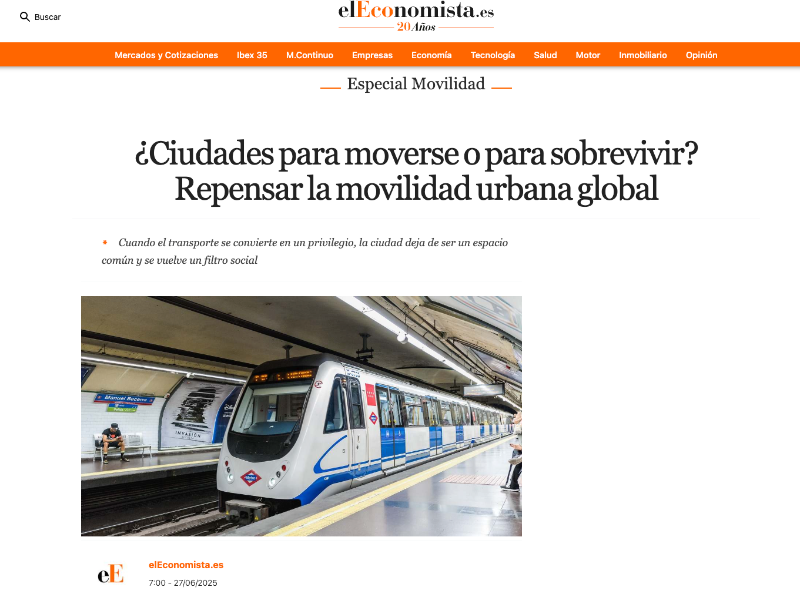
This article reflects on global urban mobility challenges across different regions, drawing on comparative observation and policy analysis. The reflections were originally published as an opinion piece in El Economista and remain highly relevant in current debates on sustainable cities, transport equity and spatial justice.
Urban Mobility Is More Than Infrastructure
A common misconception is that urban mobility problems can be solved primarily through infrastructure investments.
While metros, trams, BRT systems and road expansions are important, they are not sufficient on their own. Mobility outcomes are shaped by broader structural factors, including:
urban planning models,
political continuity and governance,
social and territorial inequalities,
and the balance between formal and informal transport systems.
Cities may deploy modern transport solutions while still reproducing exclusion if mobility policies fail to address accessibility, affordability and spatial integration.
Different Cities, Shared Structural Tensions
Across regions, cities face distinct realities but often share similar underlying tensions.
In Western Europe, cities such as Amsterdam, Copenhagen or Paris have progressively prioritised people over vehicles through integrated public transport, active mobility and low-emission policies. These choices reflect long-term political visions rather than purely technical decisions.
In contrast, cities like Madrid illustrate the friction between legacy car-oriented models and emerging sustainable mobility agendas, often subject to political shifts.
In Latin America, Africa and parts of the Middle East, cities such as São Paulo, Cairo, Casablanca, Lagos or Nairobi navigate a constant tension between modernisation and inequality. Formal systems coexist with informal transport, long commutes disproportionately affect peripheral populations, and mobility often becomes a matter of endurance rather than choice.
Despite these differences, the core question remains remarkably similar everywhere.
Mobility as a Question of Dignity and Rights
At its core, urban mobility is a question of dignity.
When access to transport depends on income, location or social status, the city ceases to function as a shared space. It becomes a social filter, reinforcing exclusion and limiting opportunity.
This perspective reframes mobility from a service to be optimised into a right to be guaranteed. It also highlights the importance of governance, policy coherence and long-term vision over short-term, fragmented solutions.
From Observation to Strategic Insight
The reflections presented here stem from cross-city observation and professional engagement with transport systems, policy frameworks and institutional contexts.
Understanding how mobility systems interact with urban form, governance and social equity is essential for designing strategies that go beyond infrastructure delivery and address the systemic nature of urban movement.
These insights continue to inform strategic advisory work focused on sustainable mobility, transport governance and integrated urban planning.
Attribution & Editorial Note
This article is an adapted version of an opinion piece originally published by El Economista (June 2025).
The reflections are shared for analytical and informational purposes, based on professional experience and comparative observation.
How This Perspective Informs Our Advisory Work
For public institutions, transport authorities and organisations involved in urban mobility and infrastructure planning, mobility must be addressed as a systemic and societal challenge.
Strategic clarity, policy coherence and spatial justice are essential to designing mobility systems that serve cities — and their citizens — sustainably.
👉 Discover how we support urban mobility, transport policy and strategic planning initiatives